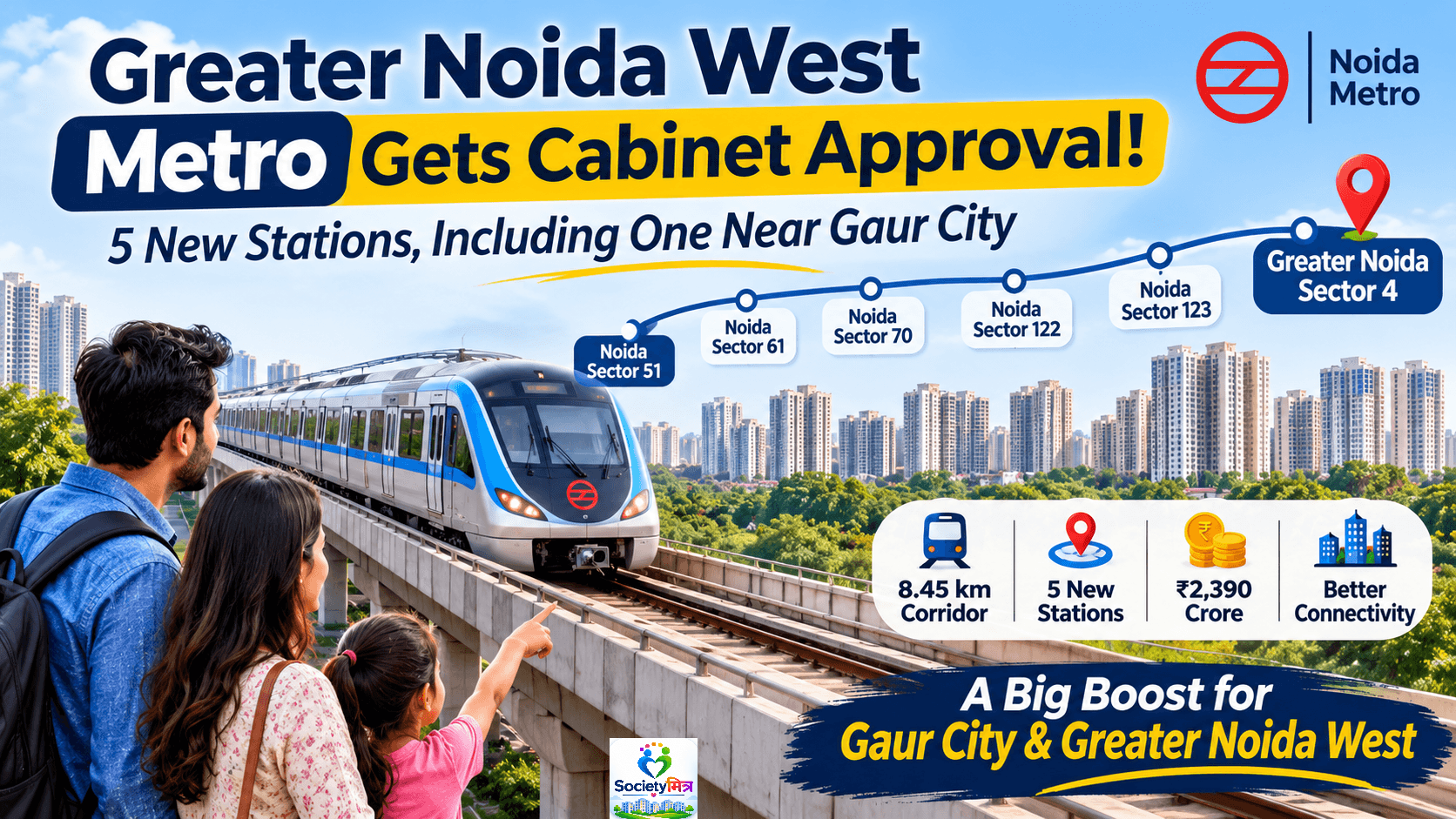
Gaur Chowk Underpass Opens for Trial: What Changes for Greater Noida West Societies
The six-lane Gaur Chowk (Char Murti Chowk) underpass in Greater Noida West opened for a trial run on 5 November, with about 14,000 vehicles using it in the first five hours. Here's how traffic now moves, which societies benefit, and when it opens fully.
If you live in Greater Noida West, chances are you have planned your day around Gaur Chowk traffic at some point. A short journey can turn into a long wait during peak hours, especially when traffic builds up around the junction.
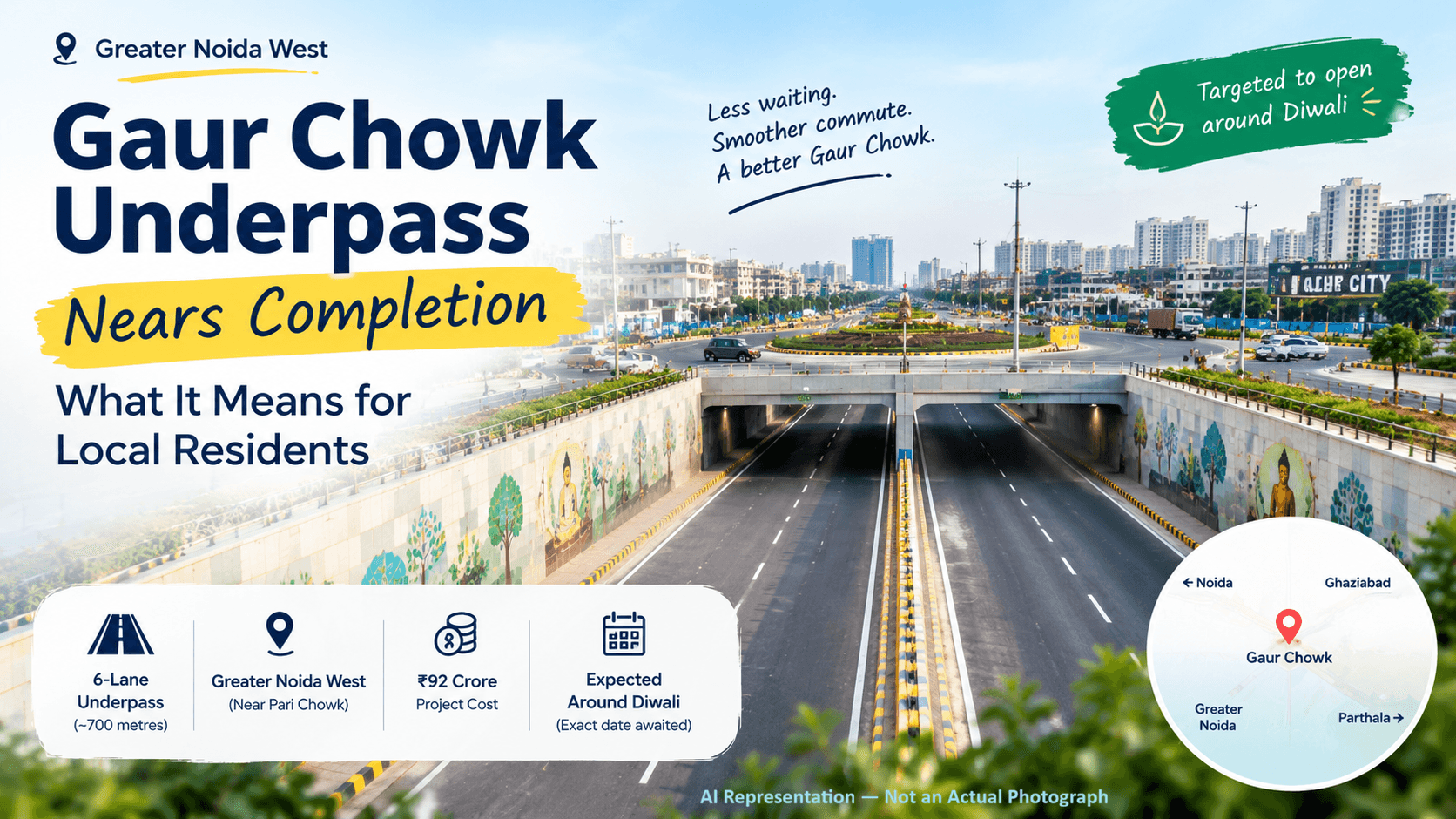
Relief has finally arrived. The six-lane underpass at Gaur Chowk, also known as Char Murti Chowk, opened to traffic on a trial basis at 6 am on Thursday, 5 November 2026. The Greater Noida Authority says about 14,000 vehicles passed through it in the first five hours alone.
The trial runs until 10 pm on Sunday, 8 November. Chief Minister Yogi Adityanath is expected to formally inaugurate the underpass on 12 November, after which it will open fully.
Here's what's been built, how traffic now moves, which societies benefit and what commuters should know.
Gaur Chowk underpass: Key details
| Detail | Information |
|---|---|
| Project | Six-lane underpass at Gaur Chowk (Char Murti Chowk) |
| Location | Greater Noida West |
| Length | About 720 metres in total, running parallel to the 60-metre road; the main covered section is about 160 metres |
| Cost | Around ₹99 crore, including a rain shelter added late in the project (initial estimate about ₹60 crore) |
| Implementing authority | Greater Noida Authority |
| Construction began | 2024 |
| Construction completed | 30 October 2026 |
| Trial run | 6 am, 5 November to 10 pm, 8 November 2026 |
| Formal inauguration | Expected on 12 November 2026 |
| Junction traffic | About 50,000 vehicles a day, according to the Authority |
| Maintenance | Reportedly assigned to the construction company for five years |
How does traffic move now?
The main idea is to reduce the number of vehicles crossing paths at the same level. Through traffic now passes underneath the junction, while local traffic continues to use the roads above.
Traffic heading towards Ghaziabad, Tigri and Gaur City: Vehicles now run through the underpass from the Hanuman Mandir roundabout towards Tigri and Ghaziabad. Traffic from Techzone 4, Sector 1, Sector 2 and the Surajpur–Kasna Road side can go straight towards Ghaziabad, Tigri and Gaur City without stopping at the junction.
No more long U-turn near the Hindon: Vehicles coming from the 130-metre and 60-metre roads towards Ghaziabad previously had to take a longer route with a U-turn near the Hindon. The Authority estimates the underpass cuts this journey by about 1.5 to 2 kilometres.
More room at the roundabout above: The Char Murti roundabout has been made smaller, freeing up extra road space for vehicles moving around the junction.
Traffic moving towards Ek Murti and Parthala: The road above continues to serve local movements between the Noida/Parthala side, Gaur Chowk and Ek Murti.
On the first day of the trial, traffic at Char Murti Chowk was reported to be moving normally. How well the new layout works during the evening rush will become clearer over the coming weeks.
What's inside the underpass?
- Six lanes for through traffic.
- A rain shelter at the entry and exit.
- Drainage designed to prevent waterlogging.
- Lighting for night-time driving.
- Wall paintings featuring India Gate, Qutub Minar, Lord Buddha and Chandrayaan.
What happens during the trial?
The trial is the Authority's chance to check the underpass under real traffic before the formal opening. Officials are watching for:
- Problems with lane movement and merging traffic.
- Points where vehicles start to queue.
- Any technical or construction defects.
Greater Noida Authority Additional CEO Sumit Yadav inspected the underpass and nearby roads with Deputy General Manager Vijay Rawal and other officials, and directed the project team to fix any problems found during the trial straight away.
Sumit Yadav said the underpass would directly benefit about 5 lakh people. Authority CEO N.G. Ravi Kumar said it would end the major traffic jam problem at the Char Murti crossing, and thanked Greater Noida West residents for their patience during construction.
The Authority also estimates the underpass could save about ₹35 crore a year through shorter journeys, lower fuel use and smoother traffic. Actual savings can only be measured once regular traffic has been running for a while.
Why did the project take longer than planned?
Construction began in 2024 with a target of about 18 months, and the deadline was extended three times. Several factors pushed it past that timeline:
- GRAP restrictions: Construction curbs imposed during periods of severe air pollution halted work at times.
- Rain: The monsoon slowed progress on site.
- Utility shifting: Underground services and electricity lines had to be moved before and during construction.
- Ramp work: Building the approach ramps took longer than expected.
The cost also rose from an initial estimate of about ₹60 crore to about ₹82 crore at the tender stage, then to around ₹92 crore with utility shifting, and finally to around ₹99 crore with the rain shelter.
Why has Gaur Chowk been such a problem for commuters?
Greater Noida West has grown rapidly over the past several years. Large residential societies have brought thousands of additional residents to the area, and many daily journeys still depend on the same road network.
Gaur Chowk connects traffic coming from several directions, including Noida, Surajpur, Crossings Republik, Ghaziabad and routes linked to the Delhi–Meerut Expressway.
Three factors have made the junction particularly challenging.
1. Residential growth has outpaced road capacity
As more high-rise societies became occupied, the number of cars, cabs, autos, buses and delivery vehicles on local roads increased. The junction has had to handle this growing demand, particularly during office hours and school runs.
2. Traffic patterns changed after the Parthala flyover opened
The Parthala flyover, also known as the Signature Bridge, opened in 2023 and improved movement around Parthala Chowk. But changes to traffic flow can shift congestion to other junctions further along a route.
Gaur Chowk is one of the places where residents experience the pressure of Greater Noida West's growing road traffic.
3. Most residents still depend on road transport
With no operational metro line serving Greater Noida West itself, many residents rely on private vehicles, cabs, autos and buses for everyday travel. That puts additional pressure on major junctions connecting the area to Noida and Ghaziabad.
Which societies benefit most?
The biggest improvement is for commuters whose regular routes pass through Gaur Chowk.
- Gaur City and nearby societies: Residents travelling through the junction see the most direct benefit.
- Societies around Ek Murti: The improved road layout helps people travelling between Ek Murti, Gaur Chowk and the Parthala/Noida side.
- Commuters from Techzone 4, Sectors 1 and 2 and the Surajpur–Kasna Road side: Through traffic towards Ghaziabad and Tigri can now bypass the junction.
- Crossings Republik and Ghaziabad residents: Those travelling towards Greater Noida may find the new arrangement easier to navigate.
- Delhi–Meerut Expressway commuters: Drivers connecting to Greater Noida West could benefit, depending on their route and the traffic conditions beyond the junction.
Residents of communities such as Gaur City and La Residentia have been looking forward to the project because of the delays they experience around this part of Greater Noida West.
However, the improvement will vary by route. If your journey involves several congested roads beyond Gaur Chowk, the underpass alone may not remove the entire delay.
Gaur Chowk is only one part of the bigger traffic plan
Greater Noida West needs improvements across several connecting roads, not just at one junction. Three projects have drawn particular attention from local residents.
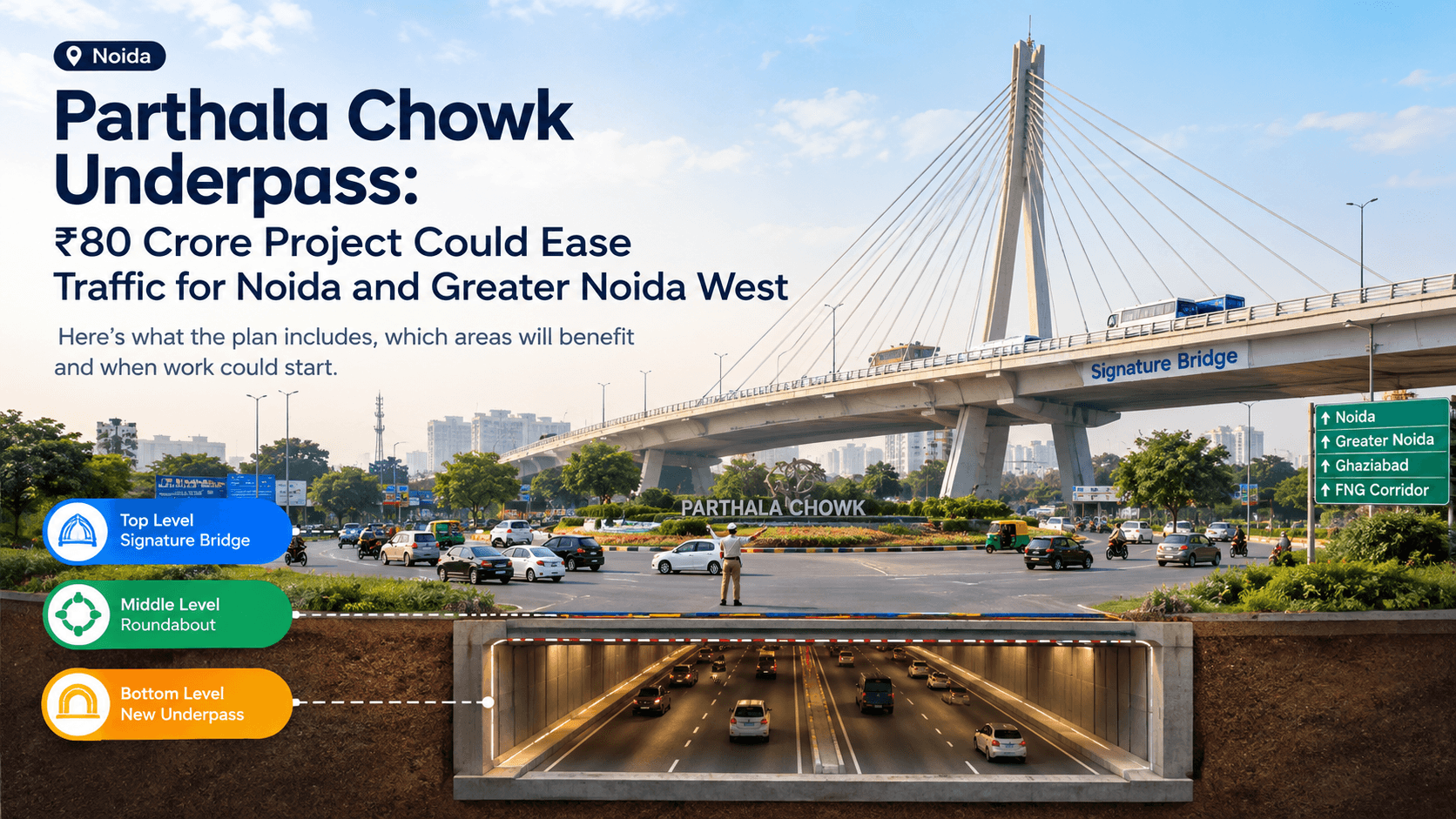
Parthala Chowk: A proposed six-lane underpass beneath the Signature Bridge is intended to improve movement around another major traffic bottleneck. Its current status and timeline should be checked against the latest Authority updates.
Gaur Chowk: The underpass covered in this article is now open on a trial basis, with the formal inauguration expected on 12 November.
Shahberi: A proposal to cover a drain and build a road above it is intended to improve connectivity along the Crossings Republik–Greater Noida West corridor. The latest tender and construction status should be confirmed before relying on a timeline.
The Greater Noida Authority has also announced broader traffic-management measures, including phased installation of traffic signals at more than 50 roundabouts and plans for over 2,700 cameras connected to a central control room. These measures are separate from the underpass and should be tracked through official updates.
Together, such projects could improve movement across the area, but their impact will depend on execution, coordination and the growth in traffic over time.
What should commuters expect during the first few weeks?
Even when a new road opens, it can take time for drivers to get used to the layout. Keep a few things in mind:
- Allow extra time initially. Drivers may need a few days to understand the new lanes and entry points.
- Follow the new signs and the traffic staff on site. Don't assume the route you have used for the past two years is unchanged.
- Be alert around merges and exits. Avoid last-minute lane changes, particularly when traffic is heavy.
- Plan festival trips carefully. Diwali, Bhai Dooj and Chhath can bring additional traffic to major junctions.
- Report recurring problems. If a particular entry, exit or turning point repeatedly causes queues, residents can document the issue and raise it with the Authority or traffic police.
The trial phase is a useful opportunity to identify practical issues before traffic patterns settle into a routine.
What can RWAs do to help residents?
Resident Welfare Associations can help make the transition easier, particularly in large societies where school buses, delivery vehicles and cabs use the same roads every day.
- Share the update. Circulate the new route information to residents.
- Inform regular drivers. School bus operators, cab drivers, delivery partners and maintenance teams should know about the changes to the road layout.
- Collect feedback. Ask residents to report specific issues, including where queues form and which turns are confusing.
- Send consolidated feedback. A clear list of recurring problems is easier for the Authority and traffic police to review than scattered complaints — and the trial period is the best time to send it.
- Keep attention on the wider corridor. Residents should continue tracking progress on Parthala, Shahberi and other road improvements that affect daily commutes.
Frequently asked questions
Is the Gaur Chowk underpass open?
Yes, on a trial basis. It opened at 6 am on 5 November 2026, and the trial runs until 10 pm on 8 November. Chief Minister Yogi Adityanath is expected to formally inaugurate it on 12 November, after which it will open fully.
Can I use it during the trial?
Yes. Vehicles, including trucks and buses, have been using it since the first morning of the trial. Follow the signs and the instructions of traffic staff on site.
How long is the underpass?
About 720 metres in total, running parallel to the 60-metre road. The main covered section is about 160 metres.
What did the project cost?
Around ₹99 crore. The initial estimate was about ₹60 crore; the cost rose with utility shifting and a rain shelter added late in the project.
Which route does the underpass serve?
It carries traffic from the Hanuman Mandir roundabout side towards Tigri, Ghaziabad and Gaur City underneath Char Murti Chowk, including traffic from the 130-metre and 60-metre roads, Techzone 4, Sectors 1 and 2 and the Surajpur–Kasna Road side.
How much time or distance will it save?
The Authority estimates that vehicles heading towards Ghaziabad from the 130-metre and 60-metre roads will save about 1.5 to 2 kilometres, as they no longer need the U-turn near the Hindon.
Are Gaur Chowk and Char Murti Chowk the same place?
Yes. The junction is commonly referred to by both names.
Will the underpass end traffic jams in Greater Noida West?
It should significantly reduce congestion at Gaur Chowk by separating through traffic from movements around the junction. But traffic problems elsewhere in Greater Noida West will still depend on other road projects, local traffic management and public transport options.
Also read
- Parthala Chowk to Get a Six-Lane Underpass: How Societies Around the Junction Will Benefit
- Shahberi Drain to Become a Road: ₹131 Crore Project Approved for the Crossings Republik–Greater Noida West Corridor
This article is based on reported project details and statements attributed to Greater Noida Authority officials. It was updated on 7 November 2026 after the underpass opened for its trial run. Reports differ slightly on some project figures, such as the exact length and cost; we have used the most recent figures reported. We will update it again after the formal inauguration.