Parthala Chowk to Get a Six-Lane Underpass: How Societies Around the Junction Will Benefit
Noida Authority is moving ahead with a ₹80 crore, 710-metre six-lane underpass beneath the Parthala Signature Bridge. Here's what it means for residents of Sectors 119–122, Sectors 71–79, Greater Noida West and nearby Ghaziabad, and when work could begin.
If you live near Parthala Chowk, you probably don't need anyone to explain the traffic problem.
During the morning rush, vehicles crawl towards the junction. In the evening, the queues build up again. Horns fill the air, and traffic police often have to step in and direct vehicles by hand to keep things moving.
The Signature Bridge, which opened in 2023, helped improve traffic movement above the junction. But the roundabout below remains a bottleneck for thousands of commuters.
Now, the Noida Authority is moving ahead with a plan that could make a difference: a six-lane underpass beneath the Parthala Signature Bridge, estimated to cost around ₹80 crore.
The idea is straightforward. Traffic travelling along the Faridabad–Noida–Ghaziabad (FNG) corridor would pass underneath the junction instead of competing for space with vehicles using the roundabout.
For residents of nearby Noida sectors, Greater Noida West and parts of Ghaziabad, the project could eventually mean less time waiting at one of the area's busiest junctions. There is still some way to go before construction begins, however.
Parthala underpass: Key details at a glance
| Project detail | Current plan |
|---|---|
| Project | Six-lane underpass, with three lanes in each direction |
| Location | Beneath the Parthala Signature Bridge, on the FNG corridor |
| Approximate length | 710 metres |
| Estimated cost | ₹80 crore |
| Implementing authority | Noida Authority |
| Expected construction period | Around 18 months |
| Current status | Detailed project report (DPR) being finalised |
| Expected construction start | By the end of 2026, according to reported Authority plans |
These details reflect the plans reported so far. The final design, tendering process and schedule will determine how the project proceeds.
How the new underpass will change Parthala Chowk
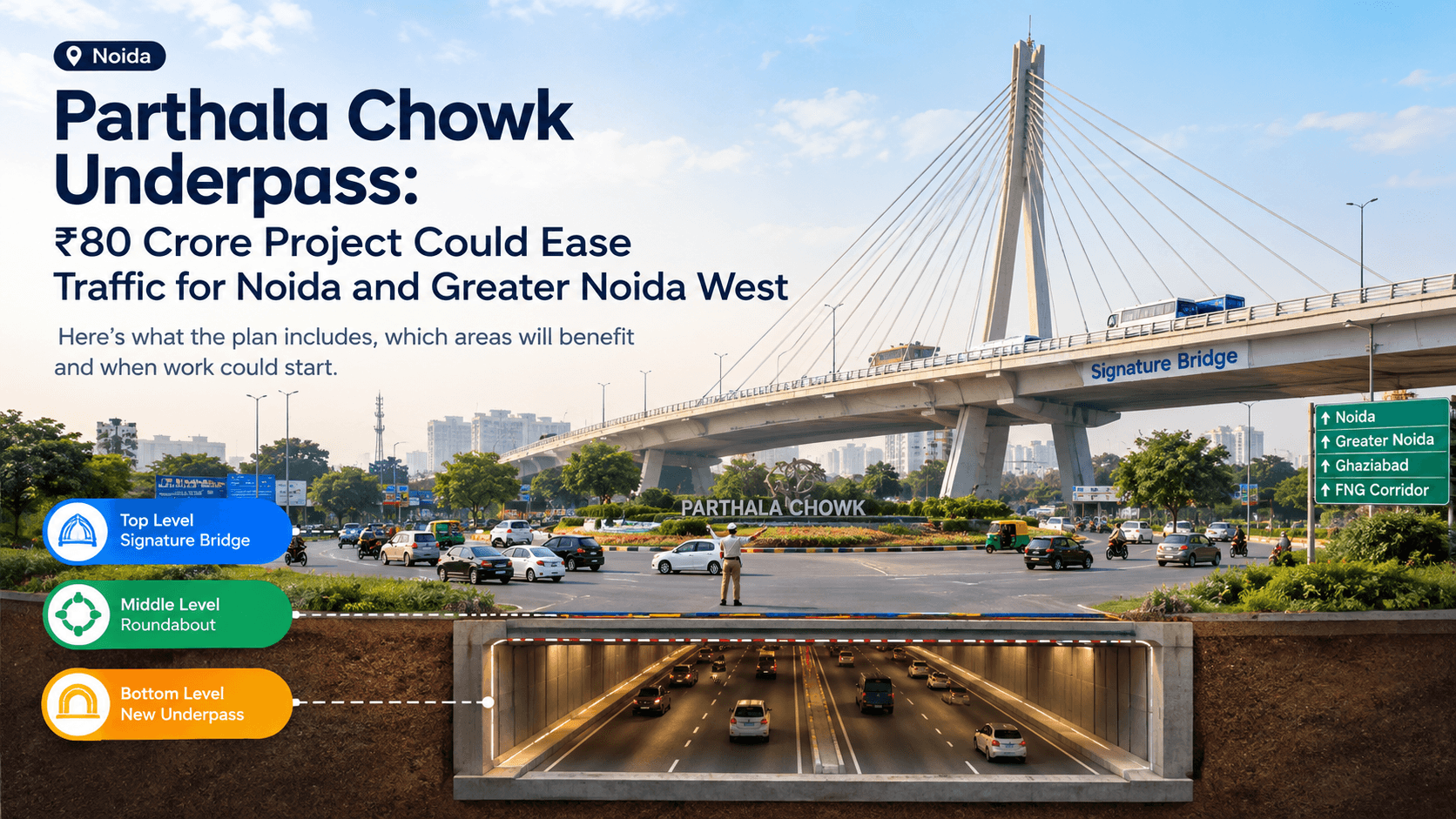
The junction will effectively have three levels of traffic movement.
- Above: the Signature Bridge. The approximately 600-metre cable-supported bridge, opened in 2023, continues to carry traffic over the junction.
- At ground level: the existing roundabout. This will continue serving vehicles that need to turn or access nearby roads and sectors.
- Below: the proposed underpass. FNG corridor traffic travelling between the Chhijarsi and Sorkha sides will be able to pass beneath the junction.
The thinking behind the project is simple: vehicles passing straight through should not have to compete with those turning at the roundabout.
Whether that translates into shorter queues for every approach will depend on the final road connections and how traffic is managed once the underpass opens.
What's included in the project?
The underpass involves more than digging a tunnel beneath the road. According to the plans reported so far, the main components include:
- An approximately 110-metre reinforced cement concrete (RCC) box section beneath the junction.
- An open section of around 20 metres.
- Approach roads of approximately 280 metres on either side, taking vehicles down into the underpass and back to road level.
- Two sumps and a pumping system to remove rainwater.
- Diaphragm walls and cast-in-situ RCC construction to help maintain soil stability and protect nearby structures, including the existing bridge, during excavation.
The drainage arrangements will be particularly important. Anyone who regularly travels through NCR underpasses knows that heavy monsoon rain can quickly turn a useful shortcut into a problem.
The proposed pumping system is intended to address that risk, although its effectiveness will also depend on proper maintenance and operation.
Why is Parthala Chowk struggling with traffic?
Parthala Chowk connects Vikas Marg with the FNG corridor and serves traffic moving towards Ghaziabad, NH-9, the Delhi–Meerut Expressway and the Noida–Greater Noida Expressway.
Recent reports put traffic through the junction at more than 1.5 lakh vehicles a day. With that many vehicles moving through a single roundabout, congestion during peak hours is hardly surprising.
The challenge could become greater as the FNG corridor develops further towards Faridabad and attracts more through traffic.
The proposed underpass is an attempt to separate that movement from local traffic. Instead of asking the same junction to handle everything, it gives vehicles travelling through the area another route.
Which residential areas could benefit?
The impact will depend on where people travel from, which direction they need to go and how the final connections are designed. These are among the areas likely to be affected.
Noida Sectors 119, 120, 121 and 122, and Chhijarsi
These neighbourhoods are among the closest to Parthala Chowk.
Residential societies in this belt include Cleo County and Homes 121 in Sector 121, along with Amrapali Zodiac and Prateek Laurel in Sector 120.
For residents who use the junction regularly, even a modest reduction in queuing could make the daily commute less frustrating. School runs, office trips and local journeys could all benefit if through traffic moves underground as planned.
The difference will be most noticeable if the roundabout remains free enough for vehicles entering and leaving these sectors.
Sectors 71 to 79
Residents along the Sector 71–79 belt also use the Parthala area to reach the FNG corridor, Greater Noida West and Ghaziabad.
A separate route for through traffic could reduce pressure on the roundabout, potentially making journey times more predictable. The actual benefit will vary by route and time of day.
Greater Noida West
For many Greater Noida West residents, the morning commute involves several busy junctions before they reach Noida or Delhi. Parthala can be one of the early hurdles.
Townships such as Gaur City have large numbers of residents travelling towards Noida and Delhi for work, education and other daily activities.
If the underpass allows FNG traffic to pass beneath the junction without interfering with local turns, it could remove one source of delay from these journeys.
It won't solve every traffic problem in Greater Noida West, but it could help at an important connection point.
Ghaziabad: Vasundhara, Siddharth Vihar and the Meerut Expressway side
Commuters travelling from Vasundhara, Siddharth Vihar and areas connected to the Delhi–Meerut Expressway may also benefit.
For those heading towards Noida and Greater Noida, smoother movement through Parthala could make the journey more consistent, particularly during busy hours.
Sorkha and surrounding areas
The Sorkha side of the FNG corridor is another important part of the plan. A direct underpass connection could improve movement through the junction for residents and other travellers using this route.
What could change for residents?
The most obvious potential benefit is time. If fewer vehicles have to stop at the roundabout, some journeys should become quicker and easier to plan.
There are other possible gains, too.
- School runs: Parents and school buses could spend less time waiting in peak-hour queues.
- Emergency vehicles: Less congestion along the corridor could help ambulances and fire services move through the junction more easily.
- Noise and emissions: Reduced idling may help cut unnecessary fuel consumption, exhaust emissions and honking.
- Road safety: Separating through traffic from vehicles turning at the roundabout could reduce some points of conflict.
These are expected benefits, not guaranteed outcomes. The final road layout, traffic management and maintenance will all influence how much improvement residents actually experience.
When will construction begin?
The project has moved from an earlier four-lane proposal to a six-lane plan, but construction still depends on the remaining planning and approval steps.
Here's the timeline reported so far:
- Late 2025: An earlier proposal for a four-lane underpass was put forward.
- August 2026: The Noida Authority announced the upgraded six-lane plan, with an estimated cost of around ₹80 crore.
- October 2026: The detailed project report is being finalised. Reports say consultancy agency DIMTS is preparing it, with IIT Delhi expected to review it before tenders are floated. Noida Authority Board approval is also reported to be required before tendering.
- By the end of 2026: Construction is expected to begin, according to the reported Authority timeline.
- Around 18 months after work begins: The expected construction period would put completion around mid-2028 if work starts by the end of 2026 and proceeds on schedule.
Mid-2028 is an indicative estimate, not a confirmed completion date. The project could take longer if approvals, tendering or construction run into delays.
What residents should keep an eye on
The underpass could bring relief once it is operational, but the construction period itself may be difficult for people who use Parthala every day.
Traffic diversions during construction
Building beneath an active junction is likely to require barricades, lane restrictions and changes to traffic movement. A detailed diversion plan has not been announced in the information available so far.
Residents should look for official updates before work starts, especially if their society's entry or exit routes connect directly to the roundabout.
Drainage and monsoon maintenance
The proposed sumps and pumping system are intended to prevent waterlogging. But installing drainage equipment is only part of the job; it must also be maintained and kept operational.
Residents will want clarity on how the system will be monitored, particularly during heavy rainfall.
Access to nearby societies
Changes to approach roads could affect local access even if the underpass itself is designed primarily for through traffic.
RWAs should raise any concerns about entry gates, service roads, school-bus routes and emergency access while the design is still being finalised.
What can RWAs do now?
Societies around Sectors 119–122, the Sector 71–79 belt, Greater Noida West and nearby Ghaziabad can start preparing before construction begins.
- Keep residents informed. Share verified project updates through society groups and notice boards.
- Ask for the traffic diversion plan. RWAs can request advance information from the Noida Authority and traffic police.
- Flag access concerns early. If a society depends on the Parthala roundabout, put concerns about entry, exit and emergency access in writing.
- Plan for everyday disruption. School buses, deliveries, domestic staff and visitor access may all need adjustments during construction.
- Track the milestones. DPR finalisation, approvals, tender award and the actual construction start will be the key developments to watch.
Joint representations from neighbouring RWAs may also help ensure that local access and safety are considered during planning.
Frequently asked questions
What is the Parthala Chowk underpass project?
It is a proposed six-lane, approximately 710-metre underpass beneath the Parthala Signature Bridge. It is intended to let FNG corridor traffic pass under the junction instead of travelling through the roundabout.
What is the estimated cost?
Around ₹80 crore, according to reports on the current proposal.
When is construction expected to start?
The reported target is by the end of 2026, subject to finalising the DPR, approvals and tendering.
How long will construction take?
The estimated construction period is around 18 months after work begins.
Will the existing Signature Bridge be removed or closed?
The proposal is for an underpass beneath the existing bridge, which is intended to continue carrying traffic above. The final construction and traffic-management arrangements will determine whether any temporary restrictions are needed during the work.
Which areas could benefit?
Likely beneficiaries include Noida Sectors 119–122, Chhijarsi, the Sector 71–79 belt, Greater Noida West, Sorkha and parts of Ghaziabad, including Vasundhara and Siddharth Vihar.
Will the underpass flood during the monsoon?
The current plan includes two sumps and a pumping system to manage rainwater. Actual performance will depend on the final drainage design and ongoing maintenance.
This article is based on statements attributed to Noida Authority officials and local media reports from August to October 2026. Project details, approvals and timelines may change. We will update this article as more confirmed information becomes available.