Shahberi Drain to Become a Road: ₹131 Crore Project Approved for the Crossings Republik–Greater Noida West Corridor
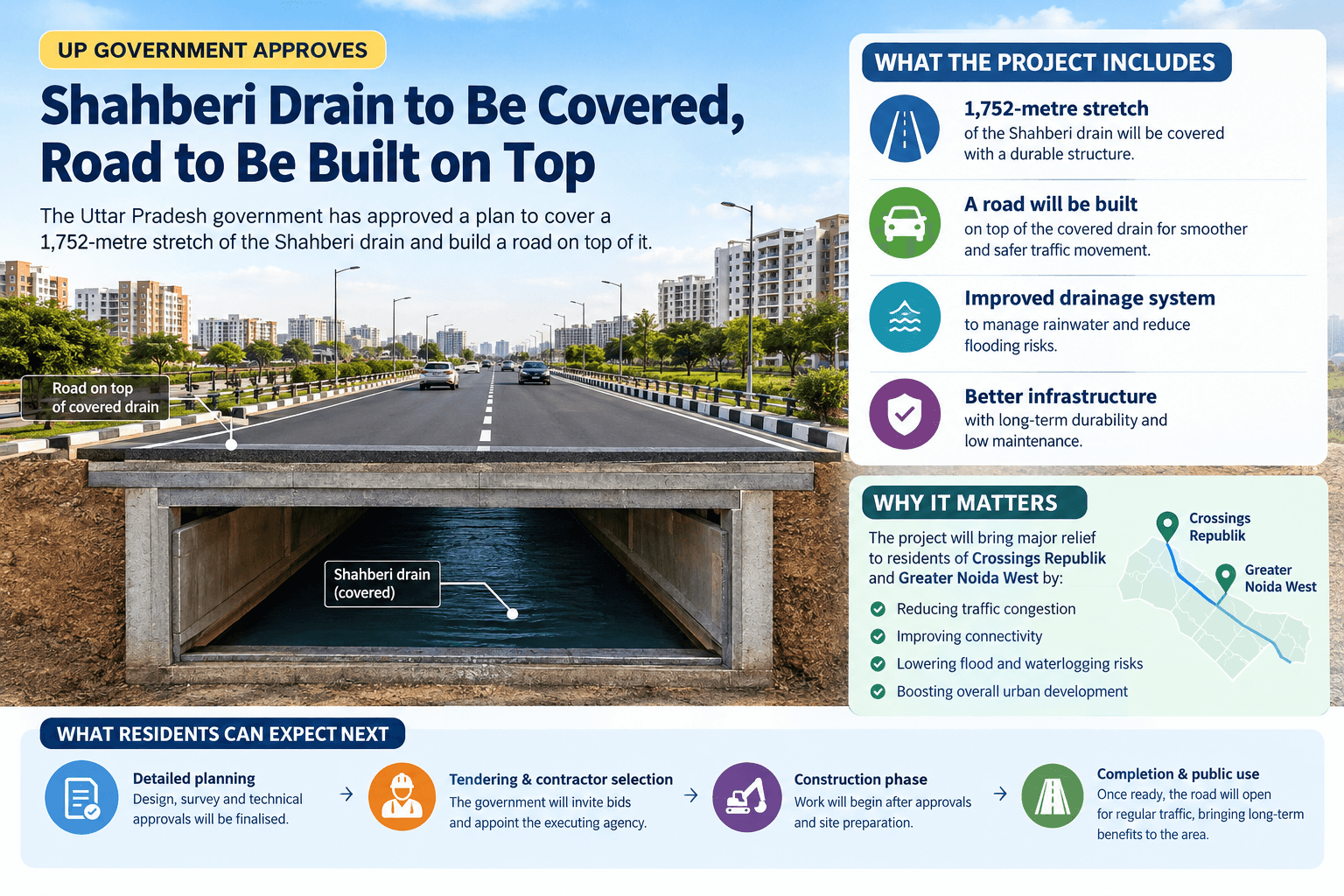
The UP government has approved a plan to cover a 1,752-metre stretch of the Shahberi drain and build a road on top of it. Here's what the project includes, why it matters for Crossings Republik and Greater Noida West, and what residents can expect next.
Updated 27 October 2026: latest on the separate Shahberi double-decker road — route, design, cost and current stage — added below.
Updated 18 October 2026: tendering is set to finish by Diwali, with construction to follow. New details on road width, drain access and the petrol pump bottleneck added below.
For years, the Shahberi corridor has been the stretch everyone in Crossings Republik and Greater Noida West plans their day around. You leave early to beat the jam, you avoid it after a downpour, and you hope the open drain alongside doesn't overflow onto the road again.
That stretch is now set for a major change. The Uttar Pradesh government has given its approval to cover the Shahberi drain and build a road on top of it, a project estimated at about ₹131 crore. Ghaziabad Mayor Sunita Dayal said it will be the first project of its kind in the city, where an entire drain is sealed and turned into a road.
Here is everything residents need to know.
| Project | Covered drain with a road built over it |
| Location | NH-9 to Shahberi, Ghaziabad (towards the Greater Noida West border) |
| Length | 1,752 metres |
| New road width | 12 metres |
| Estimated cost | About ₹131 crore |
| Scheme | Urban Flood and Smart Water Drainage |
| Built by | C&DS (Construction & Design Services) |
| Approved by | Government of Uttar Pradesh |
| Status | Tender to be completed by Diwali; construction to start after that |
What exactly will be built
The project has two parts that work together.
A covered drain. The open drain along this stretch will be rebuilt as a fully enclosed channel, 1,752 metres long. It will run from the railway line near the South Side industrial area, past ABES College on NH-9, towards Shahberi. Earlier plans for this drain described its end point as the Shahberi culvert opposite Crossings Republik.
A road on top. Once the drain is sealed, the space above it becomes a road. This is the clever part: the corridor gains extra road space without acquiring new land, because the land is already there under the drain.
The project was cleared as part of a larger ₹215 crore drainage package that the state approved for Ghaziabad this month.
The new road will be 12 metres wide and will run parallel to the existing Shahberi road, giving vehicles coming from NH-9 an additional route towards Shahberi instead of squeezing everyone onto one narrow carriageway.
The drain will stay accessible underneath. According to Nagar Nigam Chief Engineer NK Chaudhary, ducts will be built every three metres along the road so the drain can still be cleaned when needed — an important detail, since a covered drain that can't be maintained would simply move the waterlogging problem somewhere else.
Why build over the drain at all? Today the road has residential buildings on one side and a roughly 12-metre-wide open drain on the other, which leaves almost no room to widen it. Turning the drain itself into a road is the only practical way to add space.
Why the Shahberi corridor matters so much
The Shahberi road is far more than a local lane. It is one of the main links between NH-9 and Greater Noida West, and it runs past Crossings Republik, a 360-acre township planned for around two lakh residents. On the other side lies Greater Noida West, one of the fastest-growing residential belts in the NCR.
The result is a road that carries far more traffic than it was ever designed for. When the Greater Noida Authority closed part of the Shahberi road for widening in 2025, its then CEO noted that thousands of vehicles pass through the Shahberi market area every day. Office-goers heading to Noida and Delhi, school buses, delivery vans, cabs and two-wheelers all squeeze through the same narrow route.
Two problems, one fix
The waterlogging problem
Anyone who has driven through Shahberi during the monsoon knows the drill. Heavy rain overwhelms the open drain, water spills onto the carriageway, and the road surface breaks up into potholes that last long after the water has gone.
This has been a recurring theme in local reporting. After the Shahberi road was widened in 2025, reports pointed out that the drains alongside were left unfinished, leading to waterlogging during rain and potholes near societies on the stretch. During heavy rain in September 2025, NH-9 was among the worst-affected roads in Ghaziabad, and Crossings Republik was among the localities where commuters struggled.
An enclosed, properly engineered drain is designed to carry storm water away instead of letting it spill over. That should help keep the carriageway dry and stop the road surface from breaking up after every downpour.
The traffic problem
Before 2025, parts of the Shahberi road were barely three metres wide, effectively a single lane. The widening added about 1.5 metres on each side, which helped, but the corridor remains a bottleneck at peak hours.
Building a road over the covered drain adds another layer of capacity right where it's needed. More road width means smoother movement, fewer standstills, and less of the stop-start crawl that turns a ten-minute drive into forty.
The benefits beyond traffic
Covering an open drain typically brings quieter, everyday improvements too:
- Less garbage dumping, since there's no open channel to throw waste into
- Fewer mosquitoes, because there's less stagnant, exposed water to breed in
- Less foul smell for homes, shops and pedestrians along the stretch
- Safer edges for walkers, cyclists and two-wheelers, with no open drain beside the road
The petrol pump bottleneck is being fixed too
One of the worst choke points on this route is near the petrol pump, where the road narrows sharply. The Public Works Department (PWD) has already issued a tender to remove this bottleneck, so the junction should improve alongside the new road.
Commuters have also pointed out that congestion continues after crossing from Ghaziabad into Gautam Buddh Nagar, towards Greater Noida West. For the whole corridor to flow smoothly, that stretch will need widening as well.
How this fits with other Shahberi plans
This isn't the only project aimed at fixing the Shahberi corridor, and it helps to know how they differ:
- 2025 road widening (Greater Noida Authority): the existing Shahberi road was widened on the Greater Noida side. This work is complete.
- Covered drain and road (Ghaziabad): the project in this story, now approved, about ₹131 crore, 1,752 metres.
- Double-decker elevated road (Greater Noida Authority): in September 2026, the Greater Noida Authority approved what is set to be Uttar Pradesh’s first double-decker elevated road. More on this below.
These are separate projects run by different agencies, but they target the same pain point from both sides of the Ghaziabad–Greater Noida border. Together, they signal that the corridor is finally getting the attention its traffic demands.
The Shahberi double-decker road: latest
The double-decker road is the biggest of these plans, and work on it has picked up. Here is where it stands as of 27 October 2026:
| Route | From the 130-metre road in Greater Noida West, through Shahberi and past Crossings Republik, towards NH-9 |
| Double-decker section | About 2.5 km, three lanes |
| Beyond that | A single-deck elevated road continues to NH-9; NHAI is expected to start work on it soon |
| Estimated cost | About ₹1,200 crore |
| Built by | Greater Noida Authority, Noida Authority, Ghaziabad Development Authority (GDA) and NHAI, jointly |
| Stage | Greater Noida Authority has written to NHAI; the detailed project report (DPR) and other work are expected to begin soon |
| Construction start | Not announced |
How it will work. One level of the elevated road will carry traffic from Greater Noida towards Ghaziabad, and the other will carry traffic from Ghaziabad towards Greater Noida. The elevated road will be 9–10 metres wide. The existing road underneath stays open as it is, for local traffic.
One more road is part of the plan. A road along the edge of the Shahberi drain will connect to the 60-metre road near Tigri, giving Greater Noida West traffic another way around the Shahberi bottleneck.
How the plan changed. A four-lane elevated road, estimated at about ₹400 crore, was proposed earlier. After talks between the Greater Noida Authority and NHAI in September, and with help from a consultant, the authorities agreed on the double-decker design instead. In September, the Greater Noida Authority approved it as Uttar Pradesh's first double-decker elevated road.
For residents, the important point is the timeline. The DPR, agreement between the partner authorities and then tendering all have to happen before construction can start, so this is a longer-term fix. The Ghaziabad covered-drain road is the one that is closer to construction.
The journey so far
- Early 2025: A proposal to rebuild the Shahberi drain with a motorable road over it is prepared. Reports at the time put the estimate at about ₹132 crore and said approval was being sought from the state.
- 2025: The proposal goes through rounds of review at the state level.
- October 2026: The state approves the project at about ₹131 crore under the Urban Flood and Smart Water Drainage scheme.
- October 2026: Tender process to be completed by Diwali; construction to begin after that, executed by C&DS.
What happens next
The Municipal Corporation plans to complete the tender process by Diwali, after which construction will begin. The work will be executed by C&DS (Construction & Design Services). No completion deadline has been announced yet.
Residents should expect some short-term disruption once work begins — rebuilding a drain alongside a busy road usually involves digging, barricading and diversions. It's an inconvenience, but a temporary one for a lasting fix.
We'll update this page as construction progresses.
What your RWA can do now
If your society is in Crossings Republik, Greater Noida West or anywhere along this corridor, here's how your committee can stay ahead:
- Share the news with residents. Post this update on your society notice board so families know what's coming and why.
- Plan for the construction phase. Think ahead about school-bus pickups, domestic help and delivery access, and visitor entry if diversions affect your gate.
- Document existing problems. If your society's entrance floods or a particular stretch near you is badly damaged, take photos and note dates now. That record is useful when you raise issues with the authorities.
- Raise concerns early and in writing. Projects are easiest to influence before construction starts. If you have specific drainage or access concerns, send them to the Ghaziabad Municipal Corporation as a formal RWA representation.
- Keep track of follow-ups. Assign one committee member to follow the project's progress and report back to residents.
Frequently asked questions
What is the Shahberi drain road project? It's a plan to replace the open drain along the Shahberi corridor in Ghaziabad with a 1,752-metre covered drain and build a road on top of it, to tackle both waterlogging and traffic congestion.
How much will it cost? About ₹131 crore. It was approved as part of a ₹215 crore drainage package for Ghaziabad.
Who approved it? The Government of Uttar Pradesh, under the Urban Flood and Smart Water Drainage scheme. Ghaziabad Mayor Sunita Dayal announced the approval.
When will construction start? The Municipal Corporation plans to complete the tender process by Diwali, with construction starting after that. No completion date has been announced yet.
Which areas will benefit? Mainly Crossings Republik, Greater Noida West, and commuters who use the Shahberi corridor to travel between NH-9, Ghaziabad and Noida.
Is this the same as the Shahberi double-decker road? No. The double-decker road is a separate, larger project: a 2.5 km, three-lane double-decker elevated road from the 130-metre road in Greater Noida West through Shahberi, continuing as a single-deck elevated road towards NH-9, estimated at about ₹1,200 crore. It is being planned jointly by the Greater Noida and Noida authorities, the GDA and NHAI, and its detailed project report is still to be prepared. The covered drain and road is a Ghaziabad project that already has state approval and is closer to construction.
How wide will the new road be? 12 metres, built over the covered drain and running parallel to the existing Shahberi road.
Will the drain still be cleaned after it is covered? Yes. Access ducts will be built every three metres along the road so the drain can be cleaned when needed.
This report is based on announcements by Ghaziabad Mayor Sunita Dayal, the Greater Noida Authority and local media coverage in 2025 and 2026, including Hindustan (27 October 2026). Project details may change as planning progresses; we'll keep this page updated.